Understanding My Scope of Practice
Developing specialist knowledge while practising safely, ethically and responsibly
What is Scope of Practice?
It is very common for professionals, as they progress through their careers, to develop particular areas of interest and expertise. Over time, this might involve undertaking further qualifications, developing specialist skills, engaging in research or bringing together knowledge from different disciplines. This is an important part of how professions grow and evolve. As practitioners develop new areas of expertise, they may begin to work beyond some of the traditional boundaries of their original profession, bringing new perspectives and approaches to the people they support.
In healthcare, we talk about this in terms of a professional's scope of practice.
Our scope of practice describes the areas in which we have the knowledge, skills and experience to work safely and effectively. It isn't necessarily something that stays the same throughout our careers. It can develop and change as we gain further education, training and experience. I see this as a very positive part of professional development. Developing specialist knowledge allows us to respond to new research, explore connections between different areas of healthcare and, importantly, improve the support we offer to our clients.
But with that opportunity comes responsibility.
As we develop expertise in new or interdisciplinary areas, it's important that our work is grounded in appropriate education, experience and critical engagement with research. It also means recognising that developing specialist knowledge and applying that knowledge competently in professional practice are related, but distinct, processes.
For me, this is an important part of responsible professional development: pursuing new knowledge, while being thoughtful about how that knowledge is developed and applied. Below, I share a little more about my professional journey, how my interests in psychology and microbiome science have come together, and the ways I am continuing to develop my expertise thoughtfully and responsibly.
Psychology
·
Microbiome
·
Gut-Brain Axis
·
Psychology · Microbiome · Gut-Brain Axis ·
Developing My Scope of Practice
-
I am a Clinical Psychologist registered with the Health and Care Professions Council (HCPC), with over ten years of post-qualification experience.
Throughout my clinical career, I have developed particular interests in child development, attachment, trauma and the complex relationships between our psychological experiences and physical health. These interests have increasingly led me to explore mind body connections. The psychological and biological processes involved in health and wellbeing.
As part of this journey, I made the decision to undertake a full MSc in The Microbiome in Health and Disease at King's College London, graduating with Distinction.
This represented a significant step in my professional development, involving an extended period of postgraduate scientific study in a discipline beyond my original clinical psychology training. The qualification has enabled me to develop a much deeper scientific understanding of the human microbiome, including its relationships with physical health, the immune system, the nervous system and the gut–brain axis.
For me, this represents a natural progression of my professional interests: bringing together my background in clinical psychology with a more detailed understanding of the microbiome and biological systems that influence psychological and physical wellbeing.
The microbiome is a particularly fascinating area because it sits at the intersection of several disciplines. It is also a rapidly developing field, where new research is continually expanding our understanding, but where many important questions remain unanswered. This makes it especially important to distinguish between what we know, what emerging evidence suggests and what we are not yet in a position to conclude.
-
Completing my Master's has provided an important scientific foundation for this next stage of my professional development. But I also recognise that expertise doesn't develop in isolation. It grows through relationships with others who bring different perspectives, deeper experience and complementary knowledge. Supervision, mentorship and engagement with wider clinical and scientific communities provide valuable opportunities to reflect, question our assumptions, receive constructive challenge and continue developing our understanding.
This feels particularly important when working across professional and scientific disciplines. While my background in clinical psychology brings an established body of knowledge and experience, microbiome science introduces different perspectives, methods and ways of understanding human health.
I believe there is enormous value in bringing these areas of knowledge into conversation with one another, while also recognising the importance of learning from those with greater experience in particular fields.
For me, developing interdisciplinary expertise is therefore not simply about acquiring new knowledge. It is also about finding the professional relationships, communities and opportunities for reflection within which that knowledge can be deepened, challenged and applied thoughtfully. I see this as an ongoing process, supported by continued learning, appropriate supervision and consultation, and engagement with the wider scientific community.
-
Completing my MSc at King's College London has provided an important foundation for my developing specialist knowledge, but maintaining expertise requires continued engagement with scientific developments, professional learning and critical reflection.
I am a member of the UK Gut Immune Brain Axis (GIBA) Network+, an interdisciplinary research network bringing together expertise across the gut, immune system and brain. I have attended the network's termly seminar series, which has provided valuable opportunities to learn from researchers working across different scientific disciplines and remain engaged with emerging evidence.
Alongside this, I continue to maintain my professional development as an HCPC-registered Clinical Psychologist through relevant CPD, clinical supervision and reflection on my professional practice.
I see these different forms of learning as complementary. My established clinical psychology experience provides one foundation, while specialist scientific education, research engagement and interdisciplinary consultation support the continuing development of my knowledge in microbiome science.
-
Teaching, supervision and facilitating learning have been important parts of my professional work for many years. During my NHS career, I developed and delivered workshops for parents, teachers, school staff and healthcare professionals on subjects including attachment, early brain development and trauma-informed care. I have also contributed to postgraduate teaching, including lecturing on Compassion Focused Therapy at University College London.
I am now developing educational workshops exploring microbiome science and the gut–brain axis. This feels like a natural progression of my previous teaching experience, bringing together my background in psychological education with the specialist scientific knowledge developed through my Master's.
As these workshops develop, I intend to pilot the material with colleagues from relevant clinical and scientific backgrounds, invite constructive feedback and seek specialist scientific review before offering them more widely. This will help ensure that the scientific information is accurate, appropriately interpreted and communicated with suitable attention to the limitations of current evidence.
I have also sought to maintain and develop the professional relationships established during my MSc at King's College London, continuing to engage with colleagues connected to the Microbiome in Health and Disease programme. I value these connections as opportunities for ongoing scientific discussion, exchanging perspectives and continuing to learn from those working within the field.
In line with this I am also pursuing opportunities to develop an interdisciplinary research career. I have submitted research fellowship applications proposing a three-year project with King's College London exploring the relationship between early psychosocial environments and the development of the infant gut microbiome.
If successful, a fellowship would provide further opportunities for specialist research training, mentorship and collaboration with experienced researchers.
I see these activities as part of a developing professional pathway, with different areas of work requiring their own appropriate education, experience, consultation and governance.
-
The Health and Care Professions Council (HCPC) provides guidance on scope of practice, recognising that healthcare professionals can develop their scope throughout their careers, including in ways that extend beyond the traditional boundaries of their original profession.
However, this development needs to be supported by appropriate knowledge, skills, experience and professional judgement.
For me, this means taking an active and reflective approach to how I develop and apply my knowledge of microbiome science alongside my established work as a Clinical Psychologist.
Recognising the boundaries of my expertise
My MSc has provided substantial specialist scientific education, but I recognise the distinction between understanding microbiome research and having the training and experience required for particular clinical applications.
I aim to be clear about what falls within my existing professional competence, what is supported by current evidence and where additional expertise or training would be needed.
Supervision, mentorship and interdisciplinary consultation
I regard professional relationships as an essential part of developing and maintaining competence.
Alongside appropriate clinical supervision, I intend to seek specialist scientific input from colleagues with expertise in microbiology and related disciplines as my educational and research activities develop.
I am also exploring the development of a small, closed interdisciplinary peer consultation group, bringing together professionals with relevant expertise who are actively working at the intersection of psychology, microbiome science, nutrition and the gut–brain axis.
I envisage this as a confidential, collegial space for shared reflection, constructive challenge and specialist discussion, where members can draw on one another's complementary expertise. This would complement, rather than replace, appropriate clinical supervision and other professional governance arrangements.
Scientific review and responsible communication
When communicating emerging microbiome research, I believe it is particularly important to distinguish between established findings, promising areas of investigation and questions that remain unanswered.
As I develop educational materials, I intend to seek scientific review, pilot workshops and incorporate feedback from colleagues with relevant expertise before offering them more widely.
This is part of my commitment to communicating scientific knowledge accurately and avoiding claims that go beyond the available evidence.
Continuing professional development and reflection
I maintain my professional development through relevant CPD, supervision and engagement with scientific research communities.
As my activities evolve, I intend to continue reflecting on my scope of practice, identifying areas where further training or mentorship would be beneficial and maintaining appropriate records of my professional learning.
Professional governance and indemnity
I also recognise the importance of ensuring that my professional arrangements remain appropriate as my work develops.
This includes reviewing my professional indemnity arrangements to ensure that any new educational, consultancy or research activities are appropriately covered before I undertake them, alongside seeking relevant professional or organisational guidance where needed.
For me, these are not simply administrative considerations. They form part of the professional structures that allow new knowledge and expertise to be developed and shared responsibly.
An ongoing process
I see professional development as an ongoing process rather than a fixed endpoint.
My aim is to remain open to new scientific knowledge and opportunities for interdisciplinary collaboration, while ensuring that my work continues to be grounded in competence, critical reflection, appropriate professional support and accountability.
We can be curious, develop new expertise and contribute to the evolution of our professions, while remaining firmly grounded in safe, ethical and evidence-informed practice.
That is the approach I aim to bring to my work.
Professional practice develops across a number of interconnected areas, each drawing on different knowledge, skills and experiences.
Inspired by the four pillars of practice described in the NHS Education for Scotland Development Framework, I have used these four dimensions to reflect on the breadth of my own professional experience and the different directions in which my work is continuing to develop.
While some areas reflect established experience, others represent newer interests and opportunities for further learning. I see these dimensions as complementary, with their relative emphasis evolving as my professional journey continues.
Four Dimensions of My Professional Practice
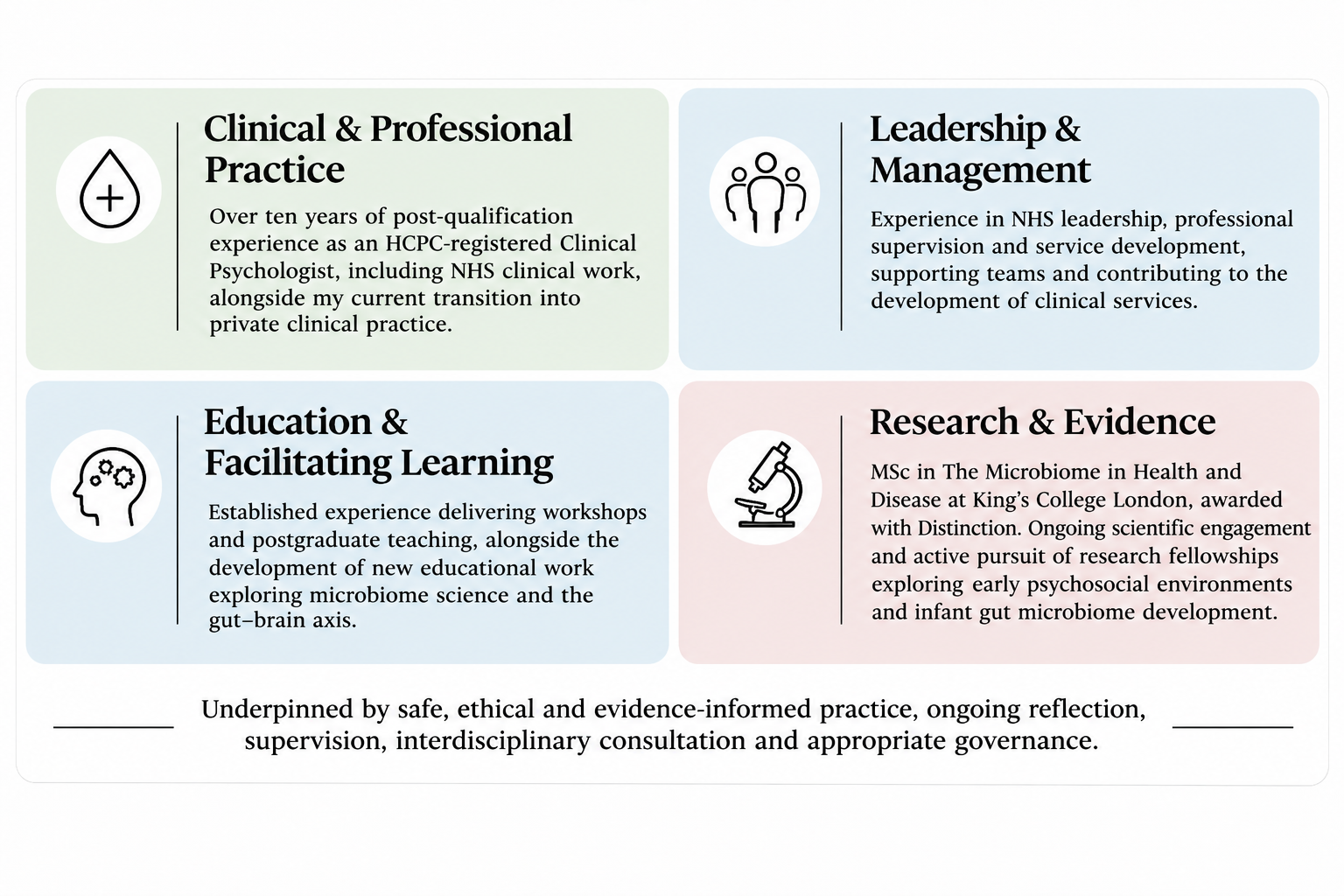
The four dimensions are adapted from the pillars of practice described in the NHS Education for Scotland NMAHP Development Framework, and have been personalised to reflect my own professional experience and development.
Contact me.
If you have any questions or would like to get in touch please do so using the form below. I will respond as soon as I can.